THANK YOU FOR SUBSCRIBING

Be first to read the latest tech news, Industry Leader's Insights, and CIO interviews of medium and large enterprises exclusively from Logistics Transportation Review



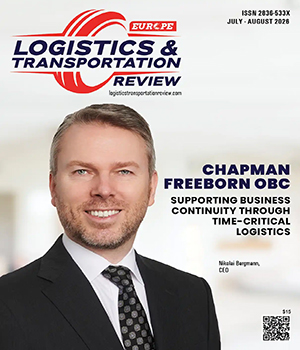
 Nikolai Bergmann, CEO
In time-critical logistics, delays quickly turn into costs.
Chapman Freeborn OBC operates in these situations, where the task extends beyond moving a shipment to restoring operations under pressure. Couriers can be deployed immediately, even when flight availability, regulatory requirements or distance create constraints. Rather than functioning as a standalone emergency service, an onboard courier (OBC) is integrated into a broader operational model for time-critical movements.
Every shipment begins with a defined requirement. Size, weight, routing and delivery timelines determine the available options. For the most urgent movements, OBC remains the primary solution. Where flexibility exists, shipments can move through next-flight-out (NFO) services within commercial networks.
When commercial schedules can no longer meet the required delivery window, Chapman Freeborn OBC escalates shipments to dedicated charter aircraft within the same operational structure, avoiding delays or handovers between providers.
“Some customers are facing penalties of up to a million dollars per hour if they are late, while others have less critical time windows,” says Nikolai Bergmann, CEO, OBC Group. “That’s why we provide them with options depending on how time-sensitive the shipment is.”
 Local Execution, Global Coverage
A number of onboard courier providers operate with small teams. In high-pressure situations, that model creates risk, delays in response, limited redundancy and no fallback when conditions change.
Chapman Freeborn OBC addresses this through a global organisational structure supported by regional teams and couriers, ensuring operational redundancy when disruptions occur.
Operations employ a “follow-the-sun” model, with teams in Europe, Asia, the U.S. and Latin America managing shipments during their respective working hours. Decisions are made during local working hours, supporting consistent execution quality.
“Nobody wants to do these graveyard shifts,” says Bergmann. “In time-sensitive logistics, the quality of work suffers when decisions are made under fatigue.”
Local presence supports this structure. When a request is received, the nearest available courier is assigned, allowing shipments to begin immediately without delays caused by long-distance deployment. This proximity is critical in time-sensitive scenarios where activation speed determines overall feasibility. In most cases, solution options are presented within minutes, enabling immediate shipment movement.
Customers remain informed throughout the shipment lifecycle, with clear visibility into available options, limitations and alternatives. Decisions are made based on time sensitivity, cost and risk, without waiting for conditions to stabilise.
Compliance-Led Execution in an Unregulated Market
OBC logistics remains a largely unregulated segment, where entry barriers are low and operational practices can vary significantly across providers.
Chapman Freeborn operates with a strict compliance and risk framework.
Each movement is evaluated against customs requirements, trade regulations and sanctions controls before transit begins. Customers are screened, routing decisions are validated and execution is aligned with regulatory constraints from the outset. This approach creates a controlled shipment lifecycle. Documentation, routing and handling remain consistent from origin to delivery, ensuring that every movement is traceable, defensible and aligned with applicable regulatory requirements. As a result, the risk of regulatory exposure or audit complications is reduced before the shipment is in transit.
Within high-stakes logistics, speed alone does not define reliability. Operational continuity is sustained by ensuring that every shipment remains compliant, auditable and precisely controlled, particularly in sectors such as aerospace, automotive and high-value manufacturing that require regulatory accountability.
Traceable Emissions, Verified Action
Sustainability is embedded within Chapman Freeborn’s shipment management framework.
Once a shipment moves, the resulting CO₂ emissions cannot be reversed. For this reason, the focus is placed on transparency, measurement and informed decision-making. Where operationally feasible, Chapman Freeborn OBC prioritises the use of available commercial capacity, efficient routing and load optimisation before escalating to more carbon intensive solutions.
In scenarios where such options are not feasible, emissions are calculated for each shipment using verified partner methodologies and are addressed through defined contribution mechanisms linked to specific initiatives.
Customers receive certification from a verified partner that records both the emissions calculated for their shipments and the corresponding contribution to specific projects. This provides a documented record that can be referenced over time, offering measurable evidence rather than a broad sustainability claim.
The approach is grounded in measurable action, ensuring each contribution is linked to a defined outcome.
When Every Hour Counts
An aircraft in Madeira, Portugal, was grounded due to a mechanical fault, leaving passengers stranded, while the required replacement part remained in Frankfurt, Germany. With less than an hour to get the part onto the next available flight, standard cargo options could not meet the timeline.
Chapman Freeborn OBC immediately assigned an onboard courier. Using an airport access permit to bypass standard freight handling procedures, the courier collected the part directly from the secure facility. Despite additional constraints, including security considerations around the shipment, the part was carried on the next available flight and delivered within hours. The aircraft was repaired and returned to service without further delay.
Situations like this fall outside normal logistics planning. When timelines collapse and operations are disrupted, the requirement shifts from transportation to operational recovery. In these moments, Chapman Freeborn OBC acts as a stabilising layer within the transport system, combining onboard courier services, commercial networks and dedicated charter capabilities within a single operational structure.
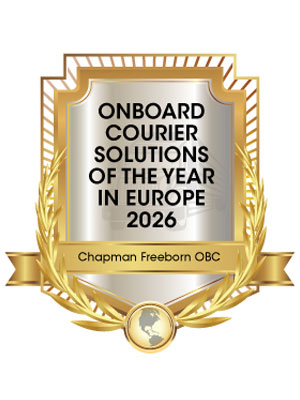
Backed by more than 50 years of air charter expertise, the company continues to support business continuity across high-stakes global supply chains, an approach that led to its recognition as the Onboard Courier Solutions of the Year in Europe 2026 by Logistics and Transportation Review Europe.
What Makes Onboard Courier Solutions Different From Standard Express Shipping?
Speed is only part of the equation. Onboard Courier Solutions involve a trained courier personally accompanying a shipment from collection through final delivery, maintaining custody throughout the journey. This approach is often used for urgent components, confidential documents, prototypes and other time-sensitive items where delays, handoffs or routing errors can create significant business disruption. Unlike conventional parcel networks, Onboard Courier Solutions prioritizes direct oversight, rapid flight access and continuous shipment visibility.
How Does Chapman Freeborn OBC Handle Time-Critical Deliveries?
When production delays, aircraft-on-ground events or urgent business requirements arise, Chapman Freeborn OBC focuses on moving shipments as quickly as possible through dedicated hand-carry services. Founded in Germany in 2006, the company operates as a specialist division within the Chapman Freeborn Group and maintains a global network of couriers positioned to respond around the clock. Its couriers personally accompany shipments from pickup to delivery, while customers receive tracking updates and direct access to support teams. These capabilities make Onboard Courier Solutions particularly valuable when every hour matters.
Which Industries Benefit Most From Onboard Courier Services?
The need for Onboard Courier Solutions often appears when downtime, missed deadlines or delayed parts carry substantial costs. Aerospace manufacturers may need replacement components immediately. Automotive production lines can require urgent parts to avoid stoppages. High-tech organizations often move prototypes, testing equipment or launch materials under tight timelines. Energy companies, financial institutions and semiconductor businesses also rely on courier services when speed, security and chain-of-custody requirements are difficult to meet through conventional shipping methods.
What Should Organizations Evaluate Before Choosing a Provider?
A provider's network, response time and shipment visibility deserve close attention. Effective Onboard Courier Solutions depend on courier availability, global reach and the ability to navigate customs and travel requirements without unnecessary delays. Buyers should ask how quickly quotations are issued, whether shipments can be tracked in real time and how the provider handles unusual destinations or urgent schedule changes. A service that appears fast on paper can create problems if communication slows once the shipment is moving.
How Do Security and Shipment Visibility Affect Delivery Outcomes?
Many urgent shipments are valuable not because of their weight but because of the consequences of delay or loss. Onboard Courier Solutions reduce risk by keeping the shipment under direct supervision throughout transit. Real-time tracking, movement updates and controlled handling help organizations maintain visibility from departure through delivery. For sensitive technology, legal documents, financial materials or prototype products, that level of oversight can prevent costly disruptions and uncertainty.
Why Is Chapman Freeborn OBC Recognized in This Category?
Chapman Freeborn OBC combines dedicated hand-carry logistics with a worldwide courier network and 24/7/365 availability. The company supports industries ranging from aerospace and automotive to semiconductors and high-tech manufacturing. Its service model includes trained, insured couriers, real-time shipment monitoring and access to additional logistics options such as Next Flight Out services for urgent cargo requirements. These capabilities help demonstrate how modern Onboard Courier Solutions can balance speed, security and global reach for business-critical shipments.
| Share this Article: Tweet |
Company
Chapman Freeborn OBC
Management
Nikolai Bergmann, CEO
Description
Chapman Freeborn OBC delivers time-critical onboard courier solutions backed by over 50 years of air charter expertise, enabling rapid, reliable and secure global shipments. Its integrated model offers flexible transport options, ensuring continuous movement and operational control when disruptions impact high-stakes supply chains.