THANK YOU FOR SUBSCRIBING

Be first to read the latest tech news, Industry Leader's Insights, and CIO interviews of medium and large enterprises exclusively from Logistics Transportation Review



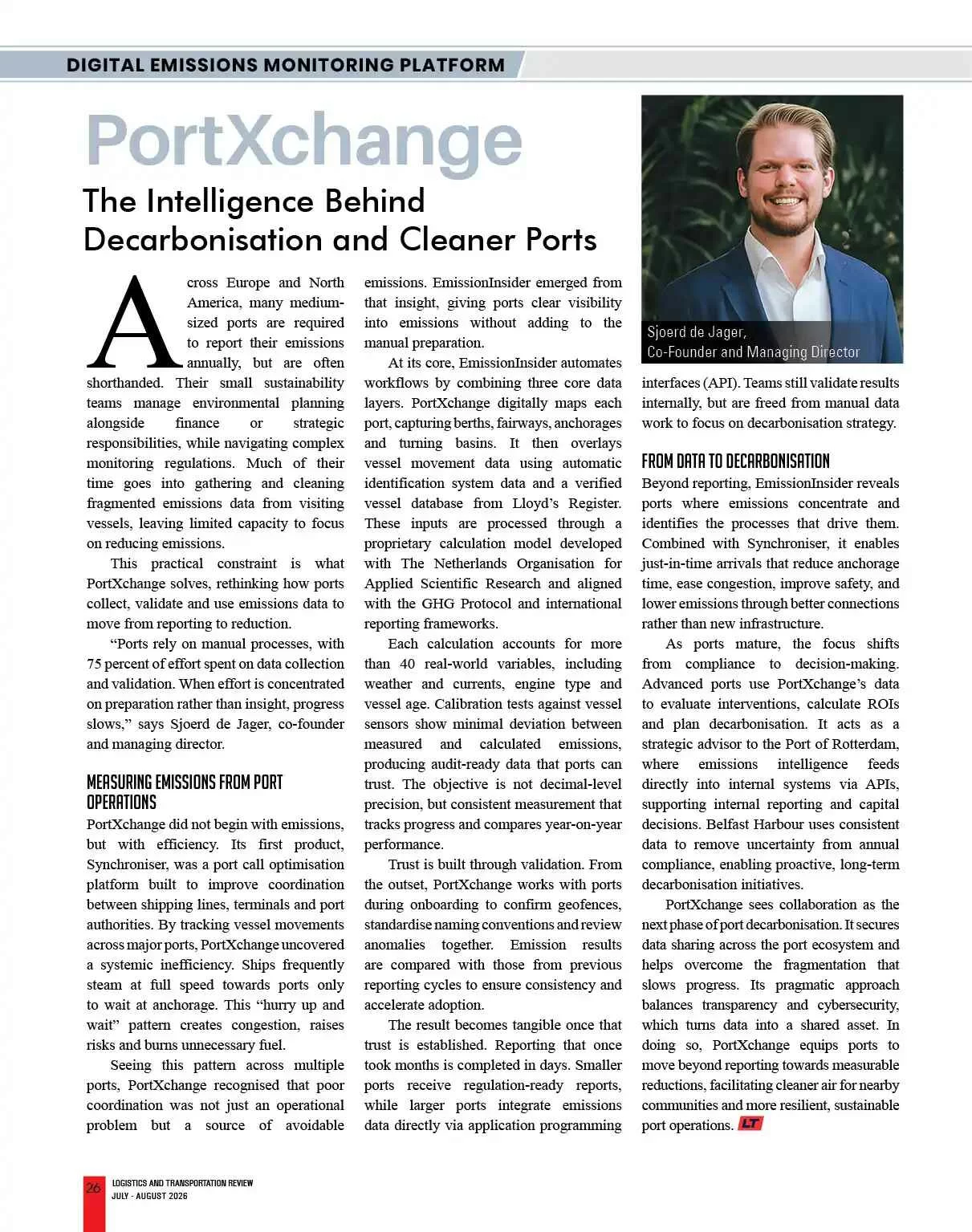
 Sjoerd de Jager, Co-Founder and Managing Director
This practical constraint is what PortXchange solves, rethinking how ports collect, validate and use emissions data to move from reporting to reduction.
“Ports rely on manual processes, with 75 percent of effort spent on data collection and validation. When effort is concentrated on preparation rather than insight, progress slows,” says Sjoerd de Jager, co-founder and managing director.
Measuring Emissions from Port Operations
PortXchange did not begin with emissions, but with efficiency. Its first product, Synchroniser, was a port call optimisation platform built to improve coordination between shipping lines, terminals and port authorities. By tracking vessel movements across major ports, PortXchange uncovered a systemic inefficiency. Ships frequently steam at full speed towards ports only to wait at anchorage. This “hurry up and wait” pattern creates congestion, raises risks and burns unnecessary fuel.
Each calculation accounts for more than 40 real-world variables, including weather and currents, engine type and vessel age. Calibration tests against vessel sensors show minimal deviation between measured and calculated emissions, producing audit-ready data that ports can trust. The objective is not decimal-level precision, but consistent measurement that tracks progress and compares year-on-year performance.
Trust is built through validation. From the outset, PortXchange works with ports during onboarding to confirm geofences, standardise naming conventions and review anomalies together. Emission results are compared with those from previous reporting cycles to ensure consistency and accelerate adoption.
The result becomes tangible once that trust is established. Reporting that once took months is completed in days. Smaller ports receive regulation-ready reports, while larger ports integrate emissions data directly via application programming interfaces (API). Teams still validate results internally, but are freed from manual data work to focus on decarbonisation strategy
From Data to Decarbonisation
Beyond reporting, EmissionInsider reveals ports where emissions concentrate and identifies the processes that drive them. Combined with Synchroniser, it enables just-in-time arrivals that reduce anchorage time, ease congestion, improve safety, and lower emissions through better connections rather than new infrastructure.
As ports mature, the focus shifts from compliance to decision-making. Advanced ports use PortXchange’s data to evaluate interventions, calculate ROIs and plan decarbonisation. It acts as a strategic advisor to the Port of Rotterdam, where emissions intelligence feeds directly into internal systems via APIs, supporting internal reporting and capital decisions. Belfast Harbour uses consistent data to remove uncertainty from annual compliance, enabling proactive, long-term decarbonisation initiatives.
PortXchange sees collaboration as the next phase of port decarbonisation. It secures data sharing across the port ecosystem and helps overcome the fragmentation that slows progress. Its pragmatic approach balances transparency and cybersecurity, which turns data into a shared asset. In doing so, PortXchange equips ports to move beyond reporting towards measurable reductions, facilitating cleaner air for nearby communities and more resilient, sustainable port operations.
| Share this Article: Tweet |

Company
PortXchange
Management
Sjoerd de Jager, Co-Founder and Managing Director
Description
PortXchange provides digital solutions that help ports, shipping lines and terminals collaborate, optimise operations and reduce emissions. It delivers accurate real-time insights and reveals operational inefficiencies that create avoidable emissions. With emissions intelligence, port-call optimisation and flexible APIs, PortXchange supports ports of all sizes in meeting regulations and building cleaner, more efficient operations.