THANK YOU FOR SUBSCRIBING

Be first to read the latest tech news, Industry Leader's Insights, and CIO interviews of medium and large enterprises exclusively from Logistics Transportation Review

A product can enter a warehouse in one form and leave ready for an entirely different requirement. Before it reaches the customer, it may need new packaging, promotional preparation, quality inspection or assembly. Returned goods can later come back through the same network and require another decision before they can move again. GEODIS builds its warehousing operations around that changing role of inventory. Across Europe, the company combines storage and fulfilment with value-added activities that can take place while goods are already inside the logistics network. Inventory can be received and managed, prepared for different order types or modified for a specific market without having to move the product to another location for that work. The distinction matters because warehousing is not simply about how much product a facility can hold. The useful question is what can happen to that product while it is there. GEODIS connects warehouse management with activities ranging from kitting and product preparation to quality control and reverse flows so that the same operation can handle different inventory requirements. Keep Inventory Ready to Move Value-added logistics depends first on control of the underlying warehouse operation. GEODIS supports receiving and inventory management alongside order processing and cross-docking. Warehouse configurations can be manual or automated, while customers can operate within multi-customer facilities or other site models suited to their volume and service requirements. The focus is on keeping inventory available for the next required activity, rather than simply holding it.
Vilma Volkovičienė, Director
Argodos Logistika has spent more than 12 years building a transportation model around responsibility, fast decisions, service consistency and long-term trust. It supports vehicle manufacturers, authorised distributors, importers and one of Europe’s largest fleet management companies to move vehicles to ports or distribution hubs without losing control of timing or cargo condition. "In logistics, we don't just move cargo, we deliver trust,” says Vilma Volkovičienė, Director. Every shipment we handle represents a responsibility to our customers, not simply another transport order.” That responsibility starts with understanding what matters most to each client in automotive logistics. One may prioritise speed, while another places greater weight on cargo safety, real-time visibility or schedule flexibility. Argodos Logistika balances those needs with consistent service, treating each assignment as part of the client’s wider supply chain rather than an isolated delivery..

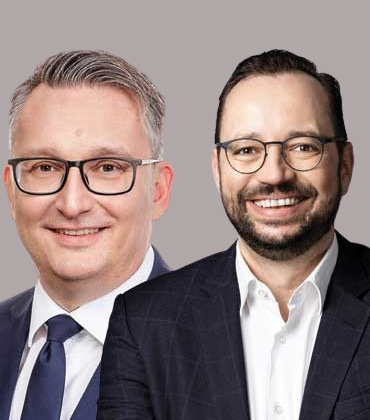
Peter Kiss, CEO, METRANS Group and Lars Neumann, General representative Intermodal, HHLA
When the Berlin Wall fell and the Iron Curtain lifted in 1989, the political changes in Europe opened vast new opportunities for trade. Yet the sudden freedom of movement also created bottlenecks, particularly on the German-Polish border where trucks often sat in long queues. It was here that Hamburg Hafen und Logistik AG (HHLA) recognized a chance to redefine freight logistics. The company looked to the railway as the answer and in doing so laid the foundation for becoming a leading European player in intermodal container traffic. Hamburg’s rail port had a broad continental reach that offered a key geographical advantage. The opening of Eastern Europe created a new hinterland, and HHLA seized the opportunity. In 1991, with the liberalization of the EU rail market, HHLA entered a joint venture with the Polish State Railways PKP and freight forwarder Egon Wenk. This marked the beginning of Polzug Polen-Hamburg-Transport GmbH, the first non-railway company permitted to run freight trains on state-owned tracks. Soon after, similar initiatives emerged in Czechoslovakia, spearheaded by Jiri Samek, who founded METRANS in Prague. METRANS introduced the hub-and-shuttle principle, operating both trains and handling terminals, and in doing so created a reliable, high-frequency network that revolutionized container transport. From Hamburg to the Heart of Europe HHLA’s stake in METRANS began in 1995 and grew steadily until the company became its sole owner. Polzug was eventually integrated into METRANS, consolidating HHLA’s intermodal strength. By the new millennium, Hamburg had reclaimed its position as Europe’s leading rail port, with HHLA and METRANS playing pivotal roles in developing routes not only across Europe but also to Asia. In 2008, the Beijing- Hamburg Container Express arrived in less than 15 days, offering a competitive alternative to sea transport. Within a decade, METRANS was managing hundreds of trains linking Europe with China. Today, HHLA’s intermodal network is one of the most comprehensive in Europe. Its seven hub terminals, supported by thirteen satellite terminals and depots in eight countries, manage around 650 trains each week. The network stretches across nineteen national borders, linking the North Sea, Baltic, Adriatic, and Black Sea regions. METRANS has become the backbone of HHLA’s inland operations, with its 2,500 employees ensuring smooth, reliable, and flexible services for customers across the continent.
Jaakko Laihorinne, CEO, Juha Murtojärvi, Head of Sales
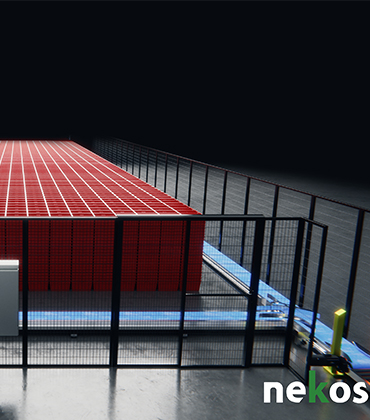
When it comes to logistics and storage, unused space, complex inventory handling, and disorganized warehouses not only slow down operations but also become liabilities over time. A key contributor to this problem is the reliance of most traditional storage systems on long conveyor lines, numerous motors, and intricate networks of sensors to move and track inventory. These systems are space-intensive, expensive to maintain, and difficult to adapt as operational needs evolve. To overcome this challenge, a smarter, more space-efficient system is needed. Nekos, a Finland-based automation expert, has developed a high-density, low-footprint storage solution that directly addresses these common pain points by drastically reducing the number of motors, sensors, and conveyors required. Its systems also minimize energy consumption, maintenance needs, and waste—resulting in a solution that is both operationally efficient and environmentally sustainable. This makes it a future-proof choice for logistics teams facing both business and environmental pressures. “Compared to old conveyor systems, our solution offers around 50 percent more capacity in the same footprint, with far fewer components. That means lower energy use, less maintenance, and a greener overall operation,” says Jaakko Laihorinne, CEO. High-Density Storage with Fewer Components At the core of this innovation is Nekos’ patented high-density tote and crate storage system, launched in 2016. Unlike traditional conveyor-based systems that require large gaps between stacks and equipment, Nekos places stacks directly on the floor with just 20 millimeters of spacing. Each stack can reach 2.2 meters in height, and a single unit can store around 40,000 crates. For growing operations, additional units can be added. Its compact footprint also allows installation in mezzanine areas or tight warehouse layouts. Nekos can customize the system for any crate or tote, offering high flexibility.
Last Mile Delivery

Henning Pottharst, Manager Global Digital Customer Experience (DCE) Smart Solutions, Hellmann Worldwide Logistics
Fleet Management

Dainius Augutis, Head of Transport Function Support Division, Girteka Group
Intermodal & Multimodal

Ferran Soler Sague, Corporate Logistics & Distribution Manager, NOEL ALIMENTARIA S.A.U
Cold Chain

Saddam Huq, Director, Cold Chain and Logistics, GSK
3PL
Tomas Hofer, VP of Supply Chain & Logistics, Notino
Supply Chain

Ana Esteves, Head of Supply Chain, Salsa
Fleet Management

Acie McMillan, Warehouse Operations Manager, S&S Activewear

Supply Chain
Veronique Kodjo, EVP of Global Manufacturing Supply Chain and Quality, CEVA SANTÉ ANIMALE

Supply Chain
Miguel Cordeiro, Director of Information Technology System, Rangel Logistics Solutions
The warehousing industry in Europe continues to expand based on eCommerce, automation, outsourcing, customisation, sustainability, cross-border commerce, technology and supply chain resilience.
Cargo transportation solutions improve logistics efficiency, shipment visibility, resilience, and cross-border trade performance.
Connecting Europe’s Logistics Networks
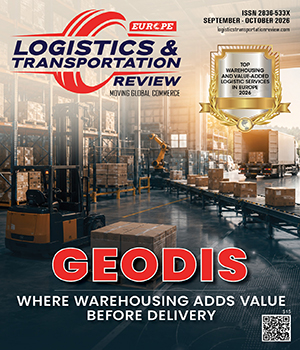
Our cover story features GEODIS, recognized as the Top Warehousing and Value-Added Logistic Services in Europe 2026. Its warehousing model goes beyond storage by bringing product preparation, kitting, repacking, quality control and reverse logistics into the same operation. Automation is applied where it suits the workload while other processes retain the flexibility of manual handling. By keeping inventory visible and combining storage with the work products may require before their next move, GEODIS gives customers greater flexibility as logistics needs change.
The issue also recognizes Argodos Logistika as the Top International Cargo Transportation Solutions in Europe 2026. Its automotive logistics model combines experienced teams, specialised carriers, real-time shipment tracking and direct communication with customers. The company coordinates hundreds of thousands of passenger vehicles each year and focuses on keeping deliveries on schedule and careful vehicle handling throughout the journey.
The issue also features perspectives from leaders working across supply chain and technology. Veronique Kodjo, EVP of Global Manufacturing Supply Chain and Quality at Ceva Santé Animale, examines the shift towards more regionalised, resilient and traceable networks while emphasising cross-functional collaboration and the importance of listening when managing change. Miguel Cordeiro, Director of Information Technology System at Rangel Logistics Solutions, considers the opportunities and risks of AI in people management, stressing the need for systems that are accountable, transparent and auditable.
Together, these stories show that resilient logistics depends on connecting technology, people and partnerships. We invite our readers to explore these perspectives and discover how practical decisions are shaping more responsive logistics networks across Europe.